



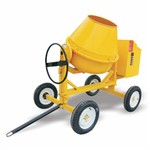
Cone Crusher
What is Cone Crusher
A cone crusher is mechanical device that reduces the size of rocks through a crushing process. It is one of several types of rock crushers that are used primarily in mining and construction. Rock crushing is a part of the processing of materials that are used in trenchless construction, such as concrete, drilling mud or gravel. Cone crusher is a type of machine widely used in urban construction, which basically reduces the size of the material with the help of compression, squeezing or breaking down between stationery and moving piece of steel. The size of the output material is controlled by managing the gap between the moving and the stationery steel parts at the lowest point. As the wedge inside the Cone Crusher rotates this cause the compression within the chamber resulting in the material to break down into smaller pieces as it goes down the wear liner. The crushed material then discharges from the bottom of the machine.
Advantages of Cone Crusher
High Crushing Efficiency
Cone crusher is designed to efficiently and effectively crush hard and abrasive materials. They utilize a rotating mantle and a concave bowl that squeeze the rocks between them, resulting in the breakdown of the rocks into smaller sizes. This crushing action, combined with the design of the chamber geometry, promotes high crushing efficiency.
Versatility in Crushing Applications
Cone crusher can handle a variety of rock types, including granite, basalt, quartz, gabbro, and more. Their ability to crush hard and abrasive rocks makes them suitable for a wide range of applications in mining and aggregate industries.
Uniform Particle Size and Shape
Cone crushers produce well-graded and cubical-shaped end products. The interparticle crushing action ensures that the final crushed material has a uniform particle size distribution. This is particularly beneficial for certain applications, such as producing high-quality aggregates for construction projects.
Adjustable and Controllable Output
Cone crushers offer the ability to adjust the size of the output material. By changing the CSS (closed-side setting) and the eccentric throw of the cone crusher, operators can control the final product size and shape according to their specific requirements.


Why Choose Us
Our Factory
Ningdu Xingye Machinery Manufacturing Co., Ltd. is located in Jiangxi, a major industrial province in China. As a global supplier of mixing equipment and parts, Ningdu Xingye Machinery Manufacturing Co., Ltd. is committed to creating added value for global customers. Ningdu Xingye Machinery Manufacturing Co., Ltd. has 15 years of professional production experience. The 20,000 square meter factory is located in the Ningdu County Industrial Park, Ganzhou City, Jiangxi Province. There are more than 100 professional production workers, equipped with staff dormitories, canteens, living and leisure areas, sports and fitness areas and other living facilities, providing employees with a good working environment.
Our Product
Ningdu Xingye Machinery Manufacturing Co., Ltd. Products includes the following:
1. Concrete Batching Plant
2. Concrete Mixer
3. Stabilized Soil Mixing Plant
4. Batching Machine
5. Cement Silo
6. Screw Conveyor
Our Certificate
We always feel that all success of our company is directly related to the quality of the products we offer. They meet the highest quality requirements as stipulated in ISO9001, ISO14000:14001 SGS guidelines and our stringent quality control system.
Our Service
Pre-sales service: We have a professional design team to customize mixing equipment according to customer needs.
In-sale service: Professional production experience, 20,000 square meters factory, workers with professional welding certificates and rich production experience. If customers have any questions, a professional team will answer them in time.
After-sales Service: Excellent after-sales installation and technical guidance.
Feed from a feed hopper is fed into a large opening at the top of the cone crusher. Feed then falls due to gravity and is crushed between the mantle and concaves; crushing takes place in the crushing chamber. As the feed moves towards the drive end of the cone crusher, its size decreases (due to the crushing action), and ever smaller pieces move towards the drive end of the crusher. After passing through the crusher, the product -now at a much-reduced size- is discharged through an opening in the bottom shell.
Crushing action is produced by the oscillation or throw (opening & closing) between the moving mantle liner, mounted on the cone, and the stationary concave liners mounted within the upper casing of the crusher. The mantle and concaves form the working surfaces of the crusher, as this is where the crushing action occurs.
The width of the discharge opening dictates the size of a crusher’s product output. The size of a crusher’s product output can be varied by raising or lowering the upper casing. This adjustment varies the size of a cone crusher’s product because the gap between the mantle and concaves is correspondingly increased or decreased. Raising the concaves (bowl liner) thus increases the product’s size output, whilst lowering the concaves decreases the product’s size output.
Because the motion of the mantle is eccentric, the gap between the mantle and concaves on one side is different to the gap on the opposite side, at any given time. When the gap between the mantle and concaves is at its largest, the opposite side gap is at its smallest. The widest gap between the mantle and concaves is referred to as the open side setting (OSS), whilst the narrowest gap is referred to as the closed side setting (CSS). Both settings are important because they describe the largest possible product size output (OSS) and smallest possible product size output (CSS). The OSS can be given as:
Eccentric motion is achieved by the lower eccentric bushing and drive arrangement at the bottom of the main shaft. The input pinion drive countershaft is supported by pinion bearings and powered by an electric motor. An external gearbox or belt drive arrangement reduces the motor speed at the crusher; typical crusher speeds range from several hundred rpm up to approx. 1000 rpm. In some cases, a clutch system may also be used to absorb shocks. The pinion on the countershaft meshes with the eccentric gear drive, or crown gear.
The inner surface of the eccentric bushing is machined off-centre from the centre-axis of the crusher. As the eccentric bushing rotates, the lower shaft oscillates in an elliptical orbit around the centreline of the crusher. This action causes the gap between the mantle and concave liners to open and close upon each rotation of the shaft. At the upper end of the mantle this movement is very small, but as the feed falls lower, the throw increases and the crushing force also correspondingly increases.
Crushed feed falls to the bottom shell assembly and is discharged to the product conveying system for further processing. The lower casing also houses a forced lubrication and hydraulic system, which is critical for the drive arrangement and tramp release cylinders (if fitted).
Jaw Crusher Vs Cone Crusher: 9 Main Differences


1. Different in working principles
The working mode of jaw crusher is curved extrusion type, and materials are crushed in the crushing chamber composed of movable jaw and fixed jaw.
The cone crusher adopts laminated crushing principle, and the mantle continuously moves towards concave to extrude the materials sandwiched between them to crush them.
2. Different in production characteristics
Generally, jaw crusher and cone crusher has the following production characteristics:
Feeding size: The feeding size of jaw crusher is relatively large, and it can generally handle materials below 1200mm, which the feeding size of cone crusher is relatively small, generally below 560mm.
Production capacity: Cone crusher has larger production capacity than jaw crusher. The largest production capacity of cone crusher can reach to 2130t/h while the largest production capacity of jaw crusher is about 1500t/h.
Compressive strength: Jaw crusher and cone crusher both can process raw materials with compressive strength within 300-350Mpa.
Tips: The specific data is based on our models of jaw crusher and cone crushers.
3. Different in materials
Jaw crusher is suitable for a variety of materials with different hardness, such as pebbles, granite, limestone, barite, etc.
Cone crusher is more suitable for materials with higher hardness, such as granite, rive pebble, basalt etc.
4. Different in positions in crushing plants
Jaw crusher has large feed opening, which is suitable for primary crushing, also known as coarse crushing;
Compared with jaw crusher, cone crusher has smaller feed opening, which is often used for secondary or tertiary crushing of materials;
5. Different in scopes of application
There are many types of jaw crushers, which can be used in large, medium and small-scaled sand and gravel production plants; cone crusher is more suitable for large and medium-sized sand and gravel production plants.
6. Different in sizes and structures
In terms of volume, jaw crusher is smaller than cone crusher. From the perspective of the overall structure, the cone crusher is 1.7-2 times heavier and 2-3 times higher than the jaw crusher with the same feeding opening size. So, it needs more money to build the factory of cone crusher.
7. Different in grain shape
Due to the crushing principle, cone crusher has better grain shape than jaw crusher. Generally, you need shaping equipment after jaw crusher for better grain shape.
And cone crusher can be used for shaping because of the adoption of lamination crushing principle, which makes the final products have good cubical shape.
8. Different in prices
Due the structures and features, cone crusher is much more expensive than jaw crusher.
9. Different in maintenance costs
In the production process of crushers, regular maintenance is necessary. Although the investment cost of cone crusher is high in the early stage, the failure rate is low in the production process, and the replacement cycle of wearing parts is long, and the maintenance and overhaul is convenient, which saves a lot of manpower and material resources.
Spring cone crusher
This type of cone crusher uses springs to provide pressure on the feed material and discharge it through the discharge opening. The springs help to absorb shock and reduce wear and tear on the crusher components.
Hydraulic cone crusher
This type of cone crusher uses hydraulic systems to adjust the crusher's settings, including the crusher's discharge opening size and the cavity's depth. The hydraulic system can also protect the crusher from damage in case of overload or irregular operation.
Compound cone crusher
This type of cone crusher combines the advantages of both the spring cone crusher and the hydraulic cone crusher. It uses a combination of springs and hydraulic cylinders to achieve a more efficient crushing process.
Symons cone crusher
This is a type of cone crusher that was originally designed by the Symons brothers in the 1920s, and it is still used today. It features a fixed bowl liner and a rotating mantle, and it can crush rock or other materials by squeezing them between the mantle and bowl liner.
Gyratory cone crusher
This type of cone crusher has a conical head and a concave surface that is covered by a manganese steel lining. The material is crushed by the gyrating motion of the head, which causes the rock to be crushed against the concave surface. Gyratory cone crushers are typically used for large-scale mining and quarrying operations.
Materials Used in Cone Crusher
The suitability of a specific raw material for cone crushers depends on its hardness, abrasiveness, moisture content, and size distribution. Here are some common raw materials suitable for cone crushers:
Limestone
As one of the most abundant and widely used raw materials, it is often used as a building material and in the production of cement. Limestone is well-suited for cone crushing due to its medium hardness. Cone crushers can efficiently reduce limestone to the desired sizes.
Granite
Granite is a very hard rock and abrasive material. Hydraulic cone crushers are able to handle granite well with their adjustable crushing cavities that can be opened or closed for size control.
Marble
Cone crushers with appropriate liners and wear parts can effectively handle the abrasiveness of marble without excessive wear and tear. Cone crushers can produce a wide range of particle sizes, allowing for flexibility in achieving the desired final product. The adjustable settings of cone crushers enable control over the discharge opening, which affects the size distribution of the crushed marble.
Pebble
Pebble generally have a hardness between 6 and 7 on the Mohs scale, which makes them moderately hard. Cone crushers are well-suited for handling materials with such hardness levels, as they are designed to handle mid-hard and above mid-hard ores and rocks.
Basalt
As a result of its high compressive strength and hardness, basalt is ideally processed using cone crushers which apply compression forces. Their design facilitates size reduction of this abrasive rock.
Dolomite
Dolomite is a sedimentary rock composed primarily of the mineral dolomite, which is a calcium magnesium carbonate. Cone crushers can handle dolomite, which is often used as a construction and aggregate material.

Application of Cone Crusher
Cone crushers are widely used in the mining industry for various applications. Here are some of the primary uses of cone crushers in mining operations:
Ore Crushing:Cone crushers are used to break down larger pieces of ore into smaller fragments. This is a crucial step in the processing of minerals, as it allows for the extraction of valuable metals or minerals.
Secondary and Tertiary Crushing:Cone crushers are often employed in secondary and tertiary crushing stages. After the initial crushing in primary crushers, cone crushers are used to further reduce the size of the ore particles.
Aggregate Production:In addition to mining, cone crushers are used in the production of aggregates for construction purposes. They can crush and shape raw materials like rocks and gravel into smaller, more uniform sizes for use in concrete and asphalt.
Quarrying:Cone crushers play a vital role in quarrying operations, where they are used to crush and process various types of rocks and stones. This is essential for the production of aggregates used in construction.
Metallurgical Operations:Cone crushers are used in metallurgical processes to reduce the size of metal-bearing ores. This facilitates the extraction of metals through processes such as smelting.
Gravel and Sand Production
Cone crushers are used in the production of gravel and sand, which are important materials for various construction projects. The crushers help in shaping and refining the final product.
Reducing Run-of-Mine Ore to Manageable Sizes
Cone crushers are used to break down large chunks of run-of-mine ore into smaller, more manageable pieces. This is a critical step in mining operations, as it prepares the ore for further processing.
Crushing Hard and Abrasive Materials
Cone crushers are well-suited for crushing hard and abrasive materials, making them suitable for a variety of mining applications where the material is challenging to process with other types of crushers.
Aggregate and Mineral Processing Plants
Cone crushers are integral components of aggregate and mineral processing plants, where they are used to crush, grind, and screen materials as part of the overall process.
How to Maintain Cone Crusher
Regular Inspection
Conduct regular inspections of the cone crusher components, including the mantle, concave, spider arm, bearings, and other parts. Look for signs of wear, damage, or misalignment.Check for loose or broken bolts and nuts and tighten or replace them as needed.Inspect the crushing chamber for any foreign objects that may have entered, which could cause damage to the crusher or affect its performance.
Lubrication
Proper lubrication is crucial for the smooth operation of cone crushers. Ensure that all lubrication points are adequately greased according to the manufacturer’s recommendations.Regularly check the oil levels in the lubrication system and top up as necessary. Also, monitor the quality of the lubricating oil and replace it at the recommended intervals.
Crushing Chamber Maintenance
Keep the crushing chamber clean and free of debris to prevent material buildup, which can lead to blockages and reduced crushing efficiency.Monitor the wear of the mantle and concave liners and replace them when they reach their wear limit to maintain optimal crushing performance.Adjust the crusher settings as needed to optimize the particle size distribution and maximize production efficiency.
Component Replacement
Over time, certain components of the cone crusher may wear out and require replacement. Common wear parts include the mantle, concave, eccentric bushing, and bearings.Follow the manufacturer’s recommendations for component replacement intervals and procedures to ensure proper functioning and extend the lifespan of the equipment.
Temperature Monitoring
Monitor the temperature of the bearings and other critical components regularly during operation. Elevated temperatures can indicate issues such as inadequate lubrication or bearing failure.Take prompt action if abnormal temperature readings are observed, such as shutting down the crusher to prevent further damage and investigating the cause of the temperature rise.