



Concrete Delivery With Pump
Classification by power type: It can be divided into electric concrete trailer pumps and diesel-powered concrete trailer pumps.
Product Details
Our product
The concrete trailer pump is a mechanical device used to transport concrete. It is mainly composed of a pump body, a delivery pipeline, a power system, a control system, and other parts. Because it is mobile and can be used flexibly at different construction sites, it is widely used in concrete delivery operations in various construction projects.


Structural composition
- Pump body: It is the core component of the concrete pump tube, mainly including the hopper, piston, distribution valve, etc. The hopper is used to store concrete, the piston pushes the concrete under the action of hydraulic pressure, and the distribution valve controls the flow direction of the concrete to ensure that the concrete can smoothly enter the delivery pipeline.
- Delivery pipeline: Generally, high-strength wear-resistant steel pipes are used, which have good wear resistance and sealing properties. According to construction needs, different lengths and angles can be installed in combination to adapt to various complex construction environments.
- Power system: usually an electric motor or diesel engine is used as the power source to provide power for the concrete pump to ensure that it can continuously and stably transport concrete.
- Control system: used to control various actions of the concrete placing pump, such as pumping speed, distribution valve switching, etc. The operator can use the control system to achieve precise operation of the equipment to ensure the smooth progress of the concrete transportation process.

Product Features
- Strong mobility, can be moved at any time according to the changes in the construction site, and adapt to different construction location requirements.
- Large transportation capacity, can meet the continuous transportation requirements of concrete in general construction projects, and can transport concrete to a longer distance and higher height.
- The operation is relatively simple. After professional training, the operator can master the operation method of the equipment, which is convenient for operation at the construction site.
- Maintenance is relatively convenient. The structural design of the equipment makes it easy for maintenance personnel to inspect, repair and replace various components, reducing the maintenance cost and downtime of the equipment.
Classification
Classification of concrete trailer pumps
- Classification by power type: It can be divided into electric concrete trailer pumps and diesel-powered concrete trailer pumps. Electric trailer pumps have low use costs and are suitable for construction sites with normal power supply and long-term fixed positions; diesel-powered trailer pumps have strong mobility and are not affected by power supply, but the use cost is slightly higher.
- Classification by discharge control method: It can be divided into gate pumps and S-valve pumps. Gate pumps can pump larger aggregate stones and are commonly used in tunnel construction; S-valve pumps have good sealing and high delivery pressure and are widely used.
- Classification by whether it has a mixing function: It can be divided into ordinary concrete trailer pumps and mixing trailer pumps. The mixing trailer pump has a high degree of automation, integrating feeding, mixing, and high-pressure pumping, which can save labor costs and is suitable for some small civil buildings or scenes where there is a need for on-site mixing of concrete.
- Classification by pumping capacity: can be divided into different models, such as HBT40, HBT60, HBT80, etc. The number represents the theoretical delivery volume per hour. The appropriate model can be selected according to the concrete demand and construction scale of the project.
- Classification by structural form: can be divided into piston type, extrusion type, hydraulic diaphragm type, etc. Piston concrete trailer pumps are more commonly used and have the advantages of high delivery pressure and high efficiency.
Certifications
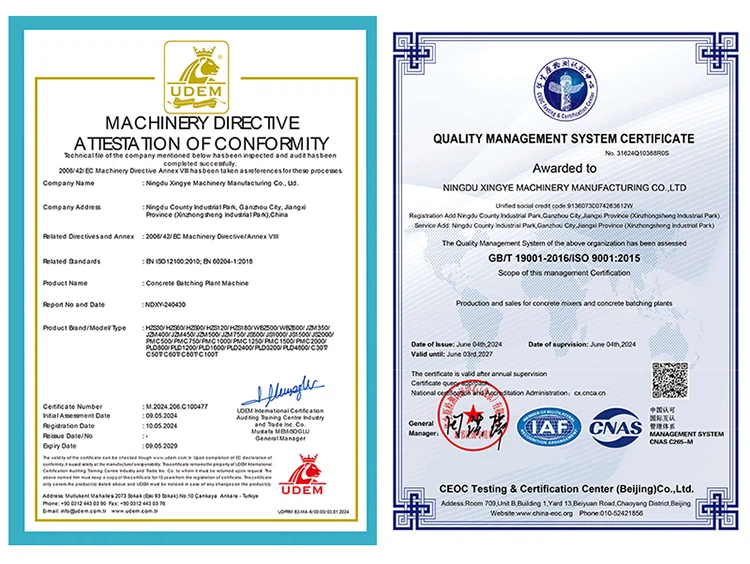
CE QMS Certificates
Our Company


Packaging And Shipping


Other Products
Items: Primary Jaw Crusher
Jaw crushers are mainly used for coarse and medium crushing of various ores in mining crushing, sand and gravel production lines, and construction crushing.
The primary jaw crusher is mainly composed of a frame, an eccentric shaft, a large pulley, a flywheel, a side guard plate, a toggle plate, a toggle plate back seat, a gap adjustment screw, a reset spring, a fixed jaw plate and a movable jaw plate.
Performance Advantages
1. Withstand strong impact
The split welded cast steel frame of the jaw crusher for stone, heavy eccentric shaft and bearing, have strong impact resistance;
A heavy guard plate is installed above the movable jaw.
2. High-quality material finishing
The jaw plate and side guard plate of the jaw stone crusher machine are made of high manganese steel, the toggle plate is made of gray cast iron, and the eccentric shaft is made of high-strength forged steel. They are made after multiple precision machining, heat treatment and flaw detection.
3. Overload protection mechanism
When the mechanical jaw crusher is working, materials that exceed its crushing capacity may enter.
These materials will have an adverse effect on the operation of the jaw crusher and may even damage the crusher.
At this time, the toggle plate will break by itself to protect the crusher equipment from damage.
4. Easy to operate and maintain
The portable jaw rock crusher has a gasket-type discharge adjustment device and a centralized lubrication system, which is easy to operate and maintain;
The jaw plate is a symmetrical structure, which can be used up and down after wear, which increases the service life and saves replacement costs.
Hot Tags: concrete delivery with pump, China concrete delivery with pump manufacturers, suppliers, factory, forced concrete mixer, new concrete batch plant for sale, jaw crusher, planetary concrete mixer, forced mixing host, dry concrete mixing plant
Product Parameter
| Towable Concrete Pump HBT40-8-62RS Technical Parameter Table | |
| Parameter list item | Technical parameters |
| Maximum theoretical concrete delivery volume | 40m3/h |
| Maximum theoretical delivery height/distance | 100/400m |
| Total power | 62KW |
| Rated speed | 2100Rpm |
| Maximum aggregate | 40mm |
| Outlet pressure | 8MPa |
| Discharge port diameter | Φ180mm |
| Delivery cylinder | Φ200×800 |
| Pumping hopper volume | 0.6m3 |
| Feeding height | 1200mm |
| Delivery pipe diameter | Φ125mm |
| Concrete slump | 160~220mm |
| Overall dimensions | 5100*1850*1950mm |
| System pressure | 28Mpa |
| Total mass | 4500KG |
Pumping capacity parameters
- Theoretical maximum displacement: refers to the volume of concrete that a concrete trailer pump can deliver per hour under ideal conditions, in cubic meters per hour (m³/h), such as the theoretical maximum displacement of HBT40 is 40m³/h. It determines the amount of concrete delivered by the equipment per unit time, and a trailer pump with a suitable displacement can be selected according to the project scale and construction progress requirements.
- Theoretical maximum delivery pressure: is the maximum delivery pressure that a concrete trailer pump can produce, in megapascals (MPa). This parameter reflects the ability of the trailer pump to overcome pipeline resistance and deliver concrete to a specified height and distance. The greater the delivery pressure, the greater the vertical height and horizontal distance that can be delivered.
Delivery system parameters
- Delivery cylinder inner diameter and stroke: The delivery cylinder is a key component of the concrete trailer pump. The size of the inner diameter and stroke affects the suction and discharge of concrete. It is usually expressed in millimeters (mm), such as 200/1600mm, indicating that the inner diameter of the delivery cylinder is 200mm and the stroke is 1600mm. Larger inner diameter and stroke can make the trailer pump have greater pumping capacity and efficiency.
- Distribution valve type: Common ones are S valve and gate valve. S valve has good sealing performance and high delivery pressure, suitable for various working conditions; gate valve can pump larger aggregate stones, often used in tunnel construction, etc.
- Maximum particle size of concrete aggregate: refers to the maximum size of aggregate (such as stone) in concrete that can be transported by concrete trailer pump, in millimeters (mm). Different types of trailer pumps have different requirements for the maximum particle size of aggregates, generally around 40-50mm. When choosing, it should be determined according to the mix ratio of concrete and actual construction needs.
- Hopper volume: The capacity of the hopper used to store concrete to be transported, in liters (L) or cubic meters (m³), such as 600L or 0.6m³. A larger hopper volume can reduce the number of loading times and improve construction efficiency.
- Loading height: The height of the hopper feed port from the ground, in millimeters (mm). The appropriate loading height is convenient for concrete mixer trucks and other loading equipment to unload, generally around 1200-1400mm.
Power system parameters
- Power form: There are two types of power: electric and diesel. Electric drag pumps have low cost, but require a stable power supply; diesel-powered drag pumps have strong mobility and are not limited by power supply.
- Main motor power/engine power: The unit is kilowatt (kW), which indicates the power provided by the power system. The greater the power, the stronger the pumping capacity and ability to overcome resistance of the drag pump.
Previous
Concrete Pumping EquipmentYou Might Also Like




Send Inquiry